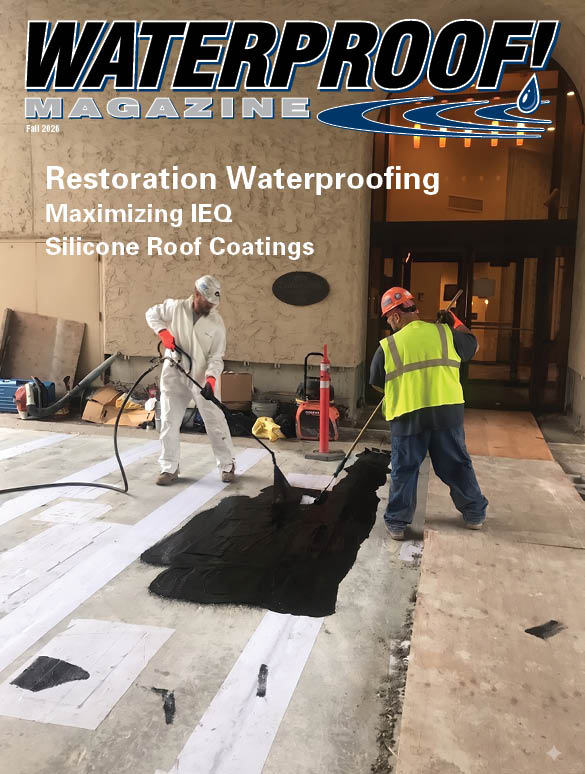
Current Issue
The stories and features in the magazine are geared toward hardworking contractors and small business owners who need relevant information, written in plain English, applicable to his business and jobsite.
WATERPROOF! Magazine reaches virtually every segment of the waterproofing industry. Coverage includes:
Residential Below Grade – Spray-applied foundation sealants, self-adhered sheet goods, footing drain tiles, dimple membranes and sump pump systems, crack repair, carbon fiber straps, piering, basement finishing, crawl-space, mold remediation, and moisture management.
Commercial Above and Below Grade – Subway tunnels, wastewater treatment plants, all facets of commercial and industrial waterproofing, underslab barriers, crystalline admixtures, polyurea coatings, curtain grouting, waterstops, blindside, above-grade air barriers, joint sealants and more.
Commercial Roofing – Single-ply, built-up, and ballasted roofing, reflective cool roofing, electronic leak detection, vegetated “green roof” systems, and spray-on coatings.
In the Current Issue:
Residential Below Grade

Ensuring Sump Pumps Perform
By Ron Greenbaum From time to time, people ask me, “what size sump pump do I need?” Short of pulling out a crystal ball, how can one give an exact answer? Too many variables exist. What if the primary pump fails? What if there is a power outage? What if...

The Importance of Certified Installers
By Melissa Morton On many projects, the quality of waterproofing depends on the quality of the installer. Certification can bring peace of mind to the owner, and additional profits to the contractor. Those of us in the waterproofing industry understand...

The Importance of Dehumidifiers
Dehumidifiers are an important component of a waterproofing system. Homeowner Danny Burns in Marysville Tenn. solved his wet crawlspace challenge by adding a sump pump, crawlspace liner and a Santa Fe dehumidifier. (see before-and-after photos at right)....
Commercial Above Grade

Electronic Leak Detection: An Update
New electronic leak detection methods can locate even the smallest leaks with pinpoint accuracy on both vertical and horizontal surfaces For almost two decades, electronic leak detection (ELD) has been used in North America to test for leaks in new and...

Joints and Waterstops
Available in a range of profiles and materials, waterstops can play a major role in preventing water leakage in concrete joints. In addition to membranes, coatings, and drainage, large commercial structures usually require some type of waterstop to keep...

Sustainable Leak-Free Roofing
Perm Ratings and Puncture Resistance – Striking the Right Balance for Optimum Performance In recent decades, the world has become more environmentally conscious, and the construction industry is no exception. The popularity of the U.S. Green Building...
Structural Repairs

Low Pressure Injection Repair for Residential Foundations
By Louis F. Cole When repairing a foundation wall with an epoxy or polyurethane foam polymer, the preferred method is low pressure injection. The secret to effective crack injection is gradual introduction of the liquid polymer into the crack at low...

Epoxy or Polyurethane Foam?
By Jay Schmid For typical residential applications, crack injection can be accomplished in less than one hour and can be done conveniently from inside the basement. A casual debate often will arise over the use of either epoxy or polyurethane foam for...

How EFVM Works
Electric Field Vector Mapping (EFVM) has a number of significant advantages over every other leak detection system on the market. Traditional flood testing methods can identify leakage, but only after the water passes through the membrane, the roof...
Order Back Issues
Showing 1–12 of 78 results