
By Errol Bull, P.E., CSI
Interior of a modern data center.
In industrial facilities and data centers, the roof is easy to overlook. In many cases, it’s seen as a passive cover that sits overhead, largely ignored until the nightmare scenario when water appears inside the building.
But as industrial infrastructure becomes increasingly critical — especially in the booming data center sector — that passive mindset is changing.
In this feature, we’re going to look at why high-solids silicone roof coatings are redefining roof asset management. We’ll explore why shifting from traditional “seamed” systems to a monolithic silicone roof coating strategy can help turn the building envelope from a depreciating problem into an active tool for risk mitigation, energy efficiency, and sustainability.
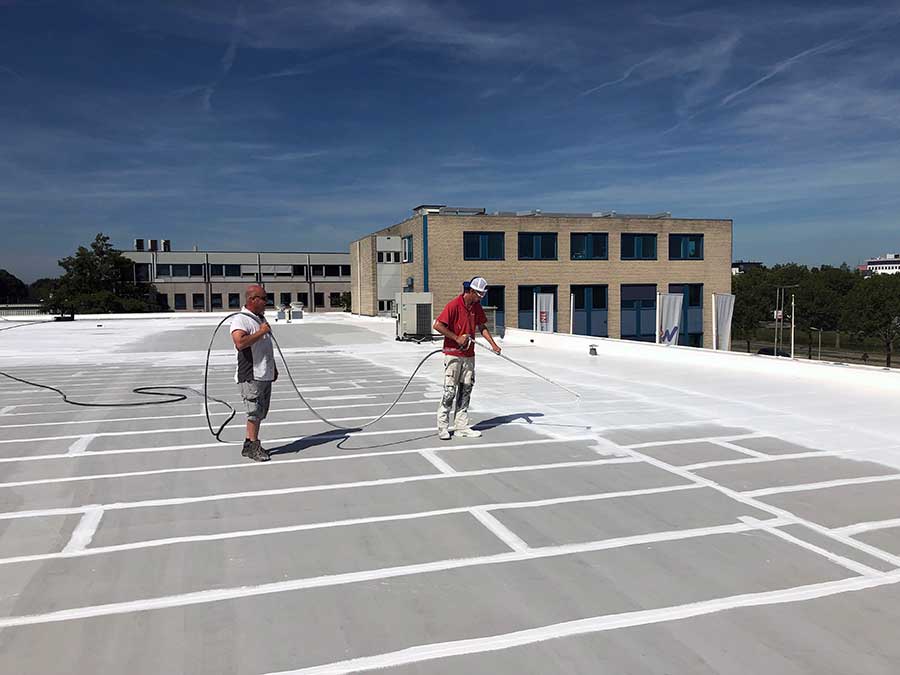
Roof coatings on a data center in Mexico. After the existing roof failed, the owner replaced it with a high-performance, 100% alkoxy silicone roof coating.
All Is Not As It Seams
In industrial asset management, water ingress is a serious risk for facilities as well as a threat to data center business models.
For decades, our industry’s default answer for large commercial and industrial buildings has been singly ply — rolled membranes like TPO, PVC, or modified bitumen. While these systems have their place, they can introduce weakness into the building design, namely in the form of seams. A 170,000 square feet (15,793 m2) roof like the one referenced later on in this article has miles of seams, all of which are potential failure points.
Today, forward-thinking asset managers are moving away from that “seamed” mindset, with the focus shifting toward liquid-applied systems that provide a monolithic, seamless defense. This isn’t just about patching leaks; it’s about protecting the underlying roof substrate with a material that helps prevent water ingress, lowers bills, and provides long-term performance.
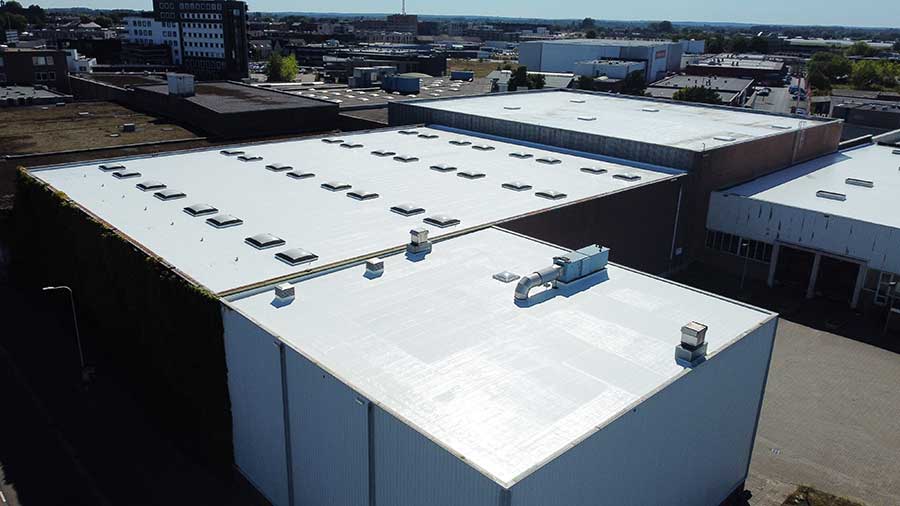
Reflective roof coatings help keep data center buildings cool.
The Failure of Traditional Materials
To understand the strategic advantage of silicone, we need to look at where traditional roofing materials fall short and why they fail. A good case study for this is a recent project in Mexico for a leading global technology infrastructure provider.
Despite being just six years old, the existing single-ply PVC system failed prematurely due to intense UV exposure and hail damage. For a colossal data center serving some of the biggest financial institutions and technology businesses in the world, that was a potentially catastrophic result.
The roofing failure highlighted a critical flaw: Organic roofing sheets simply do not withstand extreme precipitation, high temperatures, and sunlight exposure over the long term.
Facing the risk of catastrophic water ingress, already damaged by hail, UV exposure, and heavy seasonal rains, the building’s owners had a choice: replace the failed system with another sheet-based roof (likely to fail again in a decade) or upgrade the asset entirely.
They selected a high-performance, 100% alkoxy silicone roof coating that created a seamless, monolithic barrier, helping to extend the asset’s life and protecting the mission-critical servers below.
Chemistry Matters
To determine why they chose silicone, it’s important to take a closer look at the chemistry. Most traditional roofing materials, such as asphalt, modified bitumen, and the PVC that failed on the above case study, rely on carbon-carbon bonds. Under the stress of UV radiation and thermal shock (the daily expansion and contraction cycle), these bonds eventually break down, leading to splitting seams.
Silicone is different. It’s semi-inorganic, and its backbone is formed of silicon-oxygen bonds, which is the same chemistry found in quartz and glass. This structure is inherently resistant to UV degradation.
When specifying a building material for waterproofing, this chemistry gives you two significant advantages:
Monolithic Integrity: By choosing a liquid-applied silicone, you eliminate the “seam” entirely. Silicone roof coatings quickly cure into a single, continuous water-proof barrier covering the entire roof and all the likely points of failure, in one seamless layer.
Ponding Water Resistance: Flat roofs often trap water. While other roof coatings can quickly degrade when submerged, silicone naturally repels water. It can sit under puddles without breaking down, making it perfect for roofs with poor drainage or run off.
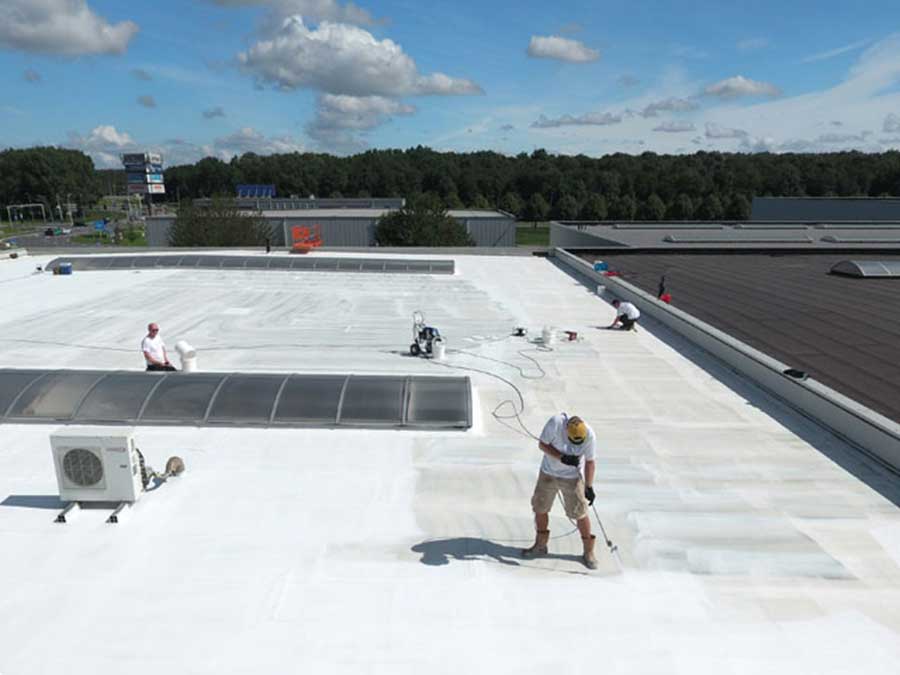
While other roof coatings can quickly degrade when submerged, silicone naturally repels water.
Bridging the Gap
As more industrial facilities adopt on-site power generation, we’re seeing a new problem emerge: the “Solar Lifecycle Gap.”
Solar Photovoltaic (PV) arrays typically carry a service life of 25 to 30 years. Conversely, standard commercial organic roofs often require replacement every seven to 10 years. This mismatch creates a logistical nightmare where you have to dismantle a perfectly good solar array just to replace the failing roof beneath it.
Choosing silicone as your base roofing system can help solve this. With warranties of up to 20 years available, silicone coatings can better align the roof’s lifespan with the array’s.
Plus, silicone roof coatings provide the elasticity required to handle the dynamic environment of a solar roof. Solar racking systems move as they vibrate in the wind and expand with heat. A rigid roofing material will eventually crack under this stress. Silicone maintains high elongation properties, moving with the racking mounts without losing adhesion or watertight integrity.
The Reflective Roof Strategy
In addition to keeping water out, the roof can help reduce operating expenses. For energy intensive operations, like the data center in Mexico, new research shows that cooling can account for up to 40% of total energy consumption (https://www.sciencedirect.com/science/article/pii/S2666123324000916).
Dark roofs or aging gray membranes act as heat sinks, absorbing solar radiation and transferring the resulting thermal load into the building envelope. This forces chillers, compressors, fans and other HVAC components to work overtime.
White silicone coatings with a high solar reflectance index (SRI) can reflect the majority of the sun’s energy away from the building.
By significantly reducing thermal load, silicone roof coatings can improve power usage effectiveness (PUE) while providing preventive maintenance for your HVAC equipment. The financial impact is immediate: industry data indicate a 10% to 50% drop in cooling energy use (https://www.epa.gov/heatislands/using-cool-roofs-reduce-heat-islands) , resulting in a direct 7% to 15% reduction in annual costs (https://www.energy.gov/sites/prod/files/2015/10/f27/LBNL-190883.pdf). Furthermore, because the equipment runs at lower intensity, white silicone coatings can help extend the lifespan of expensive assets, defer replacement costs, or even downsize infrastructure for future projects.
Sustainability Through Preservation
Finally, it’s important to talk about sustainability. The construction industry is under immense pressure to reduce waste, and the “tear-off” culture is a major offender.
Stripping a large roof generates tons of waste from insulation, membrane, and fasteners, all of which embody carbon and head straight to the landfill. Choosing a system that requires regular tear-offs is poor environmental stewardship and asset management.
Silicone roof coatings support a long-term strategy. Because it can be recoated at the end of its warranty period without removing the existing layers, it helps divert massive volumes of waste from landfills, transforming the roof from a disposable consumable into a permanent, more sustainable asset.
Conclusion: The Seamless Roof
The Case Study discussed in this feature demonstrates that the “remove and replace” cycle of traditional roofing is becoming obsolete. By embracing high-performance silicone technology, facility managers can address the immediate threat of water leaks while also meeting broader business goals: synchronizing solar assets, reducing energy consumption, and helping meet sustainability targets.
Errol Bull, P.E., CSI,
Errol Bull, P.E., CSI, is an application development leader at Momentive Performance Materials Inc. Member: IIBEC, ASTM C24, ISO TC59/SC8. With over 25 years of global experience in construction sealants, adhesives, and coatings, Errol is an expert in structural glazing and sealant performance. He holds a bachelor of science in architectural engineering and a master of science in civil engineering. In 2006, Momentive Performance Materials became the global licensee of GE-branded silicone sealants and coatings, continuing the tradition of turning advanced silicone technology into practical construction solutions. For more information, visit https://siliconesforbuilding.com
Fall 2026 Back Issue
Price range: $4.95 through $5.95
Managing the Roof as a Building Asset
What Contractors Need to Know Before Taking on Restoration Waterproofing
The Monolithic Defense: Why Silicone is the Strategic Play for High-Stakes Assets
Indoor Environmental Quality Starts From the Ground Up
Description
Description
Managing the Roof as a Building Asset
By Vanessa Salvia
Many owners can’t say what kind of roof their building has. Even if they do know, the attitude often amounts to: We’ll deal with it when it leaks.
What Contractors Need to Know Before Taking on Restoration Waterproofing
By Vanessa Salvia
New-construction waterproofing gives contractors a known substrate. This is something restoration work almost never offers.
The Monolithic Defense: Why Silicone is the Strategic Play for High-Stakes Assets
By Errol Bull, P.E., CSI
Shifting from traditional “seamed” systems to a monolithic silicone roof coating strategy can transform the building envelope from a depreciating liability into a durable, high-performing investment.
Indoor Environmental Quality Starts From the Ground Up
By Vanessa Salvia
IEQ is a broad term that describes everything that shapes how healthy, comfortable, and durable a home actually is. And according to the EPA, it deserves more attention than it gets.
Additional Info
Additional information
| Weight | N/A |
|---|---|
| Magazine Format | Digital Download Magazine, Print Mailed Magazine |