By Vanessa Salvia
Photos courtesy of Sika Corporation
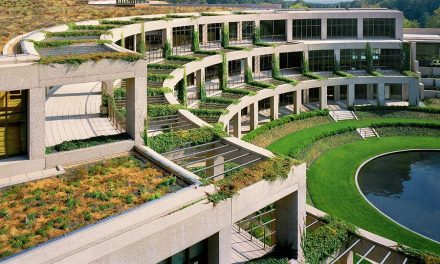
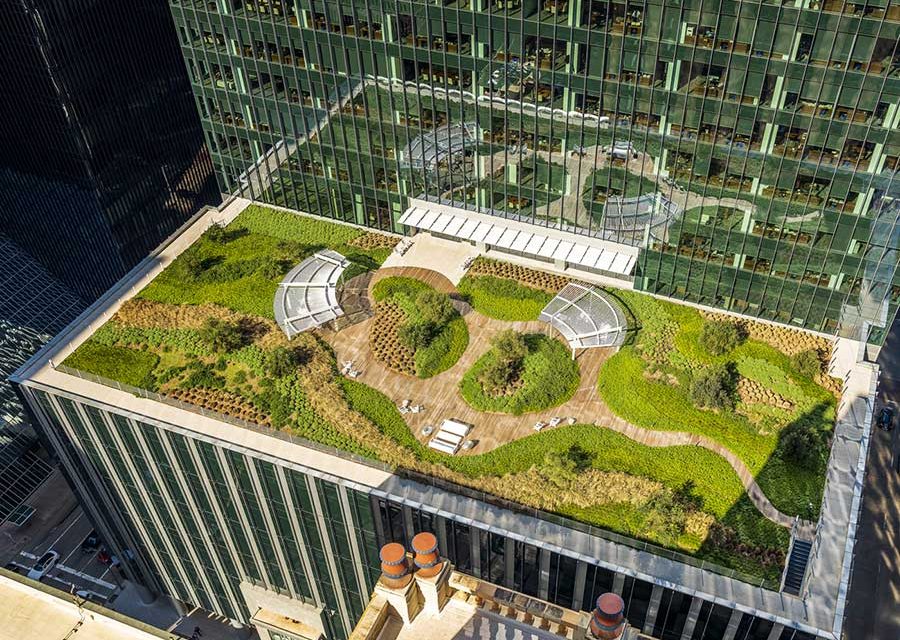
Bank of America in Houston is a 35-story tower with a 20,000-square-foot SkyPark, which is the largest green roof in downtown Houston to be open to all building tenants. This project features a 50,000-gallon rainwater collection designed to meet 100% of landscape irrigation and toilet flushing water demand.
Roofs are no longer just protective surfaces. Now, they are considered key pieces of urban stormwater infrastructure. As cities across the United States face increasing pressure to manage stormwater runoff, roofing professionals are part of that conversation.
The Problem with Runoff
When rain falls on a conventional rooftop, it typically moves quickly and directly into the storm sewer system. In densely urban areas, large amounts of water can overwhelm municipal drainage infrastructure, contributing to flooding, erosion, and pollution in local waterways. Managing this runoff has traditionally meant building detention ponds or underground storage tanks that hold water and release it slowly. This is harder to do in dense urban environments. That’s where rooftops become an asset.
“In a more urban area where you don’t have the site footprint, you need to find a place for that storm water,” says Tricia Billings, director of the Garden Roof Department at Sika Corporation. “Stormwater tanks, typically underground or above ground in a garage area, hold water and then slowly move that water into the stormwater system.”
Rooftop stormwater systems can reduce or even eliminate the need for those underground or above-ground solutions, depending on local code requirements.
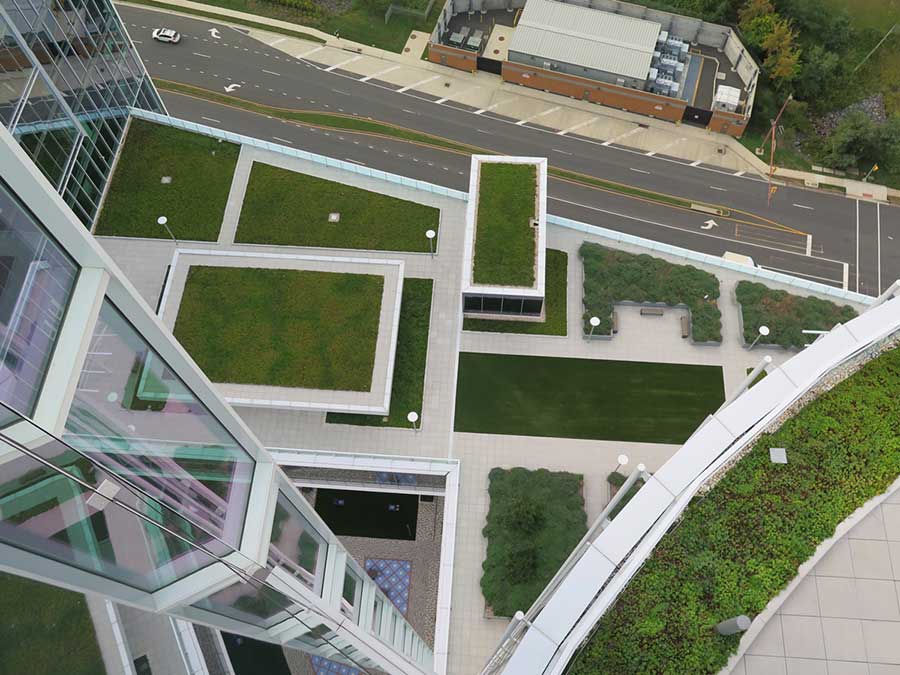
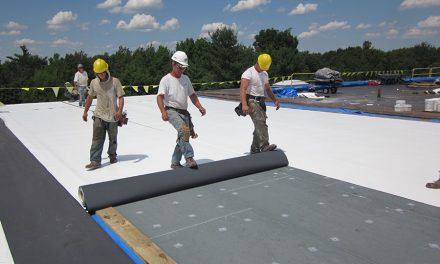
The Reston Gateway Tower in Reston, Virginia, is a mixed-use office building which includes a garden roof assembly. Hydrotech’s Garden Roof and Ultimate Assembly protect the podium deck that connects both buildings.
A Spectrum of Solutions
Not all rooftop stormwater systems are the same. Billings describes three main categories: the green roof, the blue roof, and the “purple roof” — which is a hybrid system developed by Sempergreen and marketed by Sika that combines elements of both.
A green roof, the most familiar of the three, is a vegetated roofing assembly that includes a drainage layer. “The drainage layer moves the water more slowly to the drain than your typical on-site drainage,” Billings explains.
Blue roofs use a large void space on the roof surface where water can pool and slowly release through a regulated outflow drain. “It’s a drain that regulates how much water is going through the storm sewer system,” says Billings. Blue roofs require a level roof surface due to the buoyancy from the water storage, and for that reason are not as widely used as other options.
The Purple Roof, Sika’s proprietary system, offers both retention and detention capabilities in a single assembly and can be used on sloped roofs. “What’s great about the purple roof is it could be on a sloped application, and you’re using a traditional drain,” Billings notes, “because that last layer — the detention layer — is slowly moving that water to the drain.”
The Purple Roof Assembly
The Purple Roof is a layered system, with each component managing water over time. The top layer is the growing media, or soil, which retains water within the assembly. Beneath that sits a layer of rock mineral wool. This is a dense, absorbent material that provides additional retention capacity. “The retention of that rock mineral wool is double what 1 inch of media is,” says Billings. This layer can be doubled up to increase retention as needed.
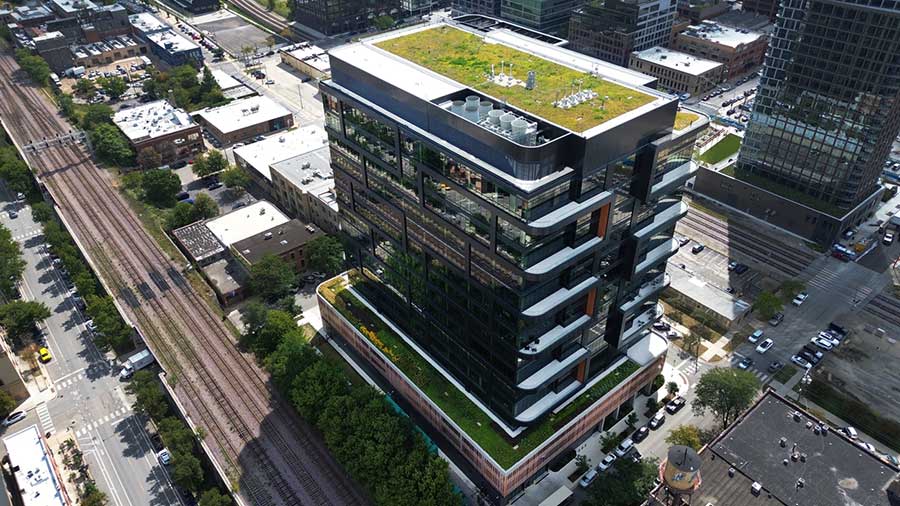
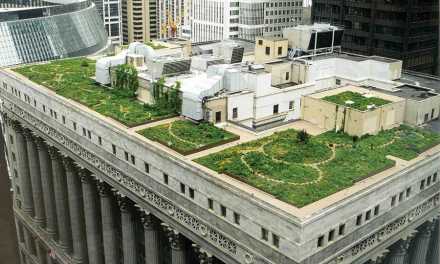
Fulton Labs at 400 N. Aberdeen in Chicago combines R&D lab space and office space.
Below the media and rock mineral wool is what Billings calls the “honeycomb layer.” This is a structural void space that detains water as it moves through the assembly. Finally, at the bottom is the detention layer, which slowly moves detained water toward the roof drain.
“The detention layer moves the water slowly,” Billings explains, “creating less stormwater going into the drain so quickly.” In typical conditions, the assembly fully drains within 24 to 48 hours.
The system is also modular. Depending on project requirements and local code, components can be removed if they’re not needed. “Sometimes, depending on the code, you may need to retain the water within the assembly without needing additional detention,” Billings says. “You can retain the water within the media and rock mineral wool, slowing down the water to the drain with the detention layer and removing the need for the honeycomb layer.”
Navigating Local Codes
One of the most important factors in rooftop stormwater planning is local code. Requirements differ significantly from city to city and state to state, and a key question is whether a given jurisdiction will count the rooftop toward its overall stormwater calculations.
“Some codes will count the roof area towards the calculations and others may not,” says Billings. “It depends throughout the U.S. where codes are more prevalent for the green roof solution.”
Demand for rooftop stormwater management tends to be highest in dense urban markets on the East Coast. “We see more stormwater tending to be on the East Coast, especially in D.C. and New York. Their requirements are much more severe than they are across the country,” Billings notes. But that may change.
Billings also points to Colorado as an emerging market, where municipal codes are actively being updated to reflect rooftop solutions. “They’re really changing their take on stormwater, especially for the rooftop,” she says. “They’re looking at the codes for the green roof and then alternatives like the purple and blue roof solutions.”
For roofing professionals working on projects with stormwater requirements, Billings recommends starting with the local code to understand both what is required and what rooftop solutions are permitted to count toward compliance. From there, the specific assembly can be engineered to meet those calculations.
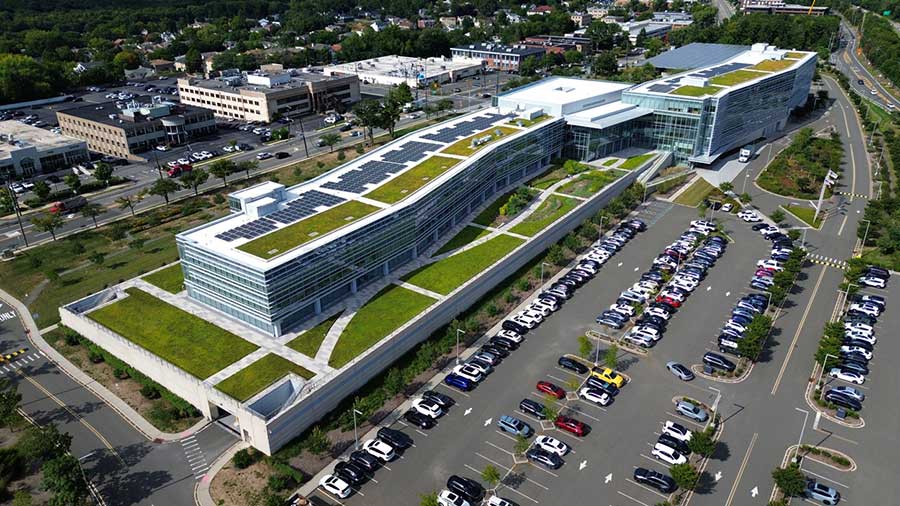
The North American headquarters for LG in Englewood, New Jersey, includes a garden roof assembly. Ballasted photovoltaic panels were installed atop white-coated Hydroguard panels.
Opportunities for Roofing Professionals
As stormwater regulations tighten in more municipalities, roofing professionals who understand these systems will be positioned to take advantage of the new opportunities. With the right knowledge, green, blue, and purple roof assemblies represent a growing market opportunity, particularly in urban infill and redevelopment projects where traditional ground-level detention solutions aren’t feasible.
The nuances of each system will be slightly different. “It really depends on the calculation,” says Billings. “First of all, your calculation is provided by the code, and then every city has different stormwater requirements.” For the past few years, green roofs and amenity decks have added value to roof spaces, especially in large cities, by adding an element of urban greenery.
Stormwater management adds more to the idea of the roof as valuable real estate and infrastructure.
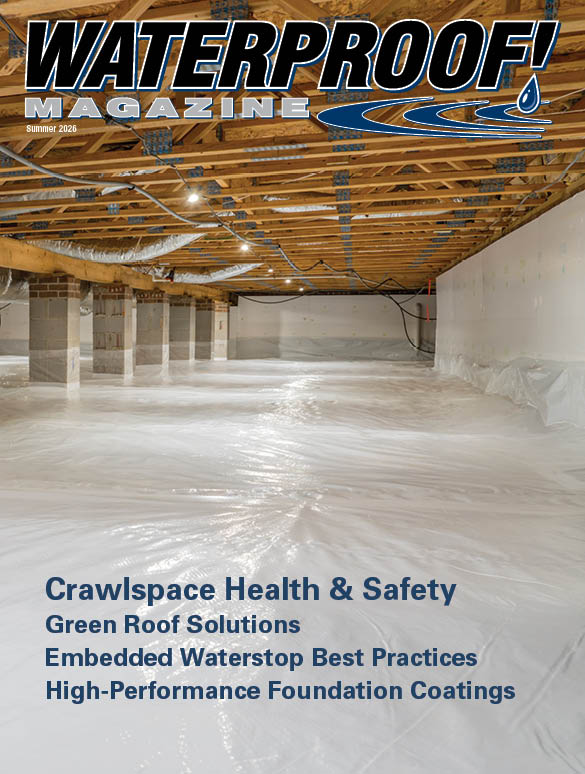
Summer 2026 Back Issue
Price range: $4.95 through $5.95
Embedded Waterstop Installation Best Practices for Durable, Watertight Concrete Joints
Crawlspace Health and Safety
High-Performance Foundation Coatings
Green Infrastructure Solutions for Today’s Rooftops
Description
Description
Embedded Waterstop Installation Best Practices for Durable, Watertight Concrete Joints
By David R. Poole
Waterstops are one of the most widely used methods for preventing water from passing through concrete construction joints. While the concept is straightforward, proper installation requires careful planning.
Crawlspace Health and Safety
By Vanessa Salvia
Left untended to, a crawlspace can undermine a home’s safety, compromise air quality, and expose its occupants to a range of biological and chemical hazards.
High-Performance Foundation Coatings
By Vanessa Salvia
Get foundation waterproofing wrong and it’s difficult if not impossible to remediate. Get it right and the building is protected for decades.
Green Infrastructure Solutions for Today’s Rooftops
By Vanessa Salvia
Roofs are no longer just protective surfaces. Now, they are considered key pieces of urban stormwater infrastructure.
Additional Info
Additional information
| Weight | N/A |
|---|---|
| Magazine Format | Digital Download Magazine, Print Mailed Magazine |