By Vanessa Salvia
Photos courtesy of Kryton

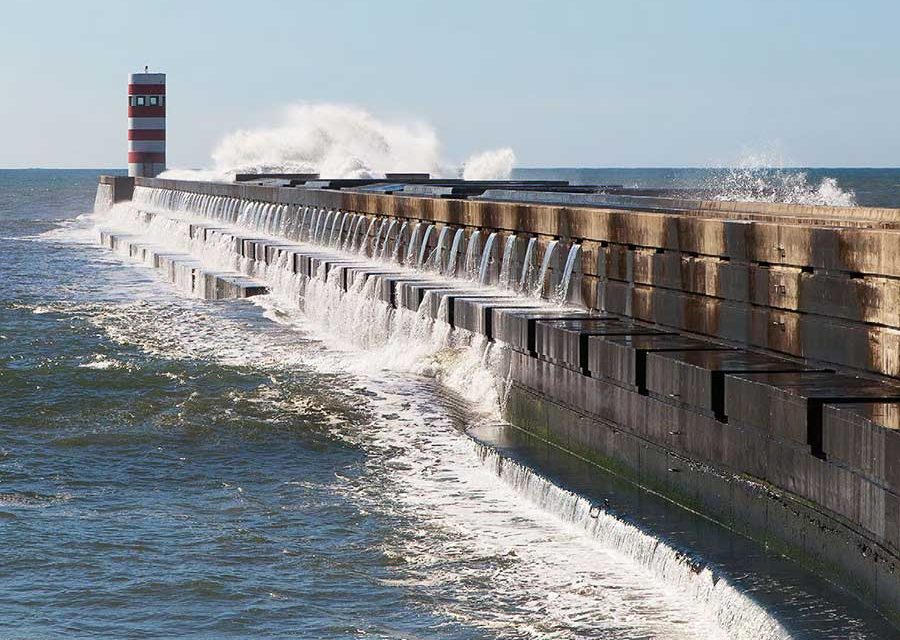
The ocean has always been a hostile place for concrete. Salt air, tidal cycles, storm surges, and neverending moisture create conditions that eat away at reinforced structures from the inside out. But as sea levels continue to rise and marine weather intensifies, the stakes for coastal and naval infrastructure have never been higher. Seawalls, dry docks, piers, and bulkheads that once seemed permanent are showing their age, and their vulnerabilities.
The consequences of concrete failure in marine environments go beyond cosmetic. They are structural, financial, and in some cases, catastrophic. A few years ago, the collapse of the Champlain Towers South condominium in Surfside, Florida, focused national attention on what corrosion-driven concrete deterioration can ultimately lead to. The building’s proximity to the ocean had allowed chloride ions to penetrate the concrete over decades, accelerating the corrosion of reinforcing steel until the structure could no longer support itself.
Kevin Yuers, vice president of product development at Kryton International, has been watching the slow deterioration of marine concrete infrastructure with mounting concern — and he wants to talk about what can be done about it.
“Without materials engineered to resist corrosion, cracking, chloride ingress, and cyclic loading, vital coastal infrastructure is at risk of premature failure, escalating maintenance costs, and loss of mission readiness,” he said.
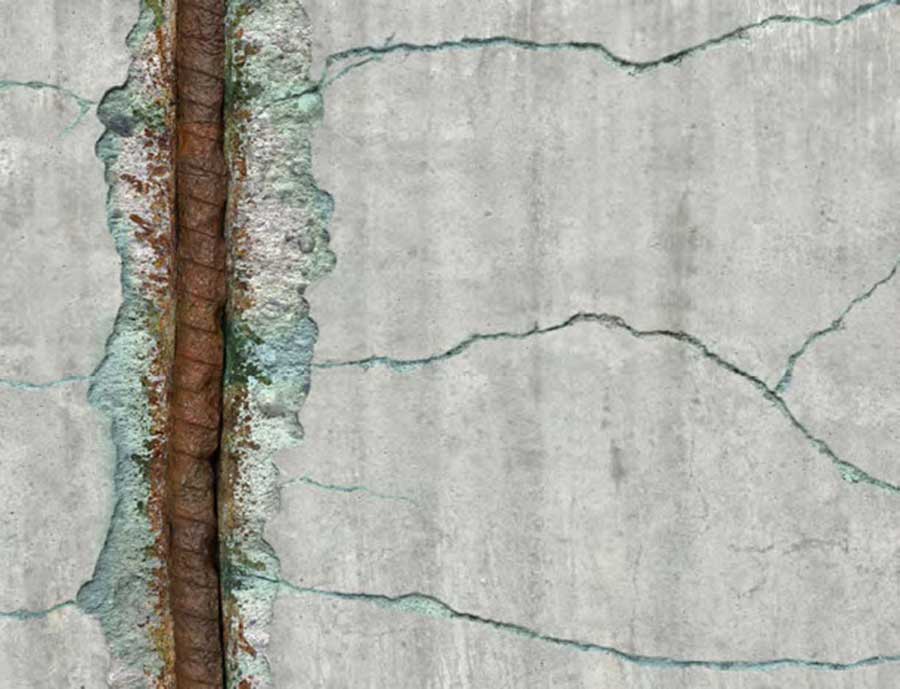
A cross section of unprotected concrete.
The Problem with Marine Concrete
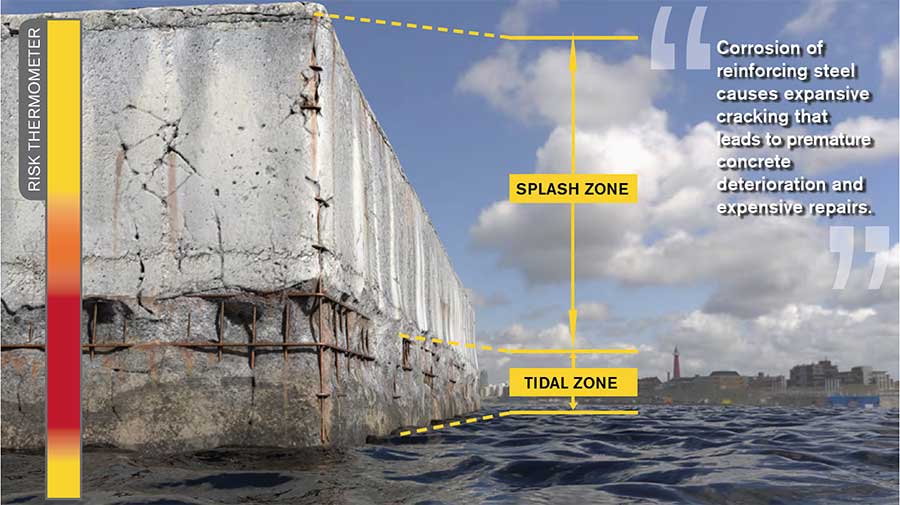
Concrete might seem like an unlikely candidate for vulnerability. It is heavy, dense, and has been used in major construction for centuries. But all concrete is naturally porous. It’s what engineers describe as a “rigid sponge.” Water finds its way in through capillary pores and micro-cracks, and in a marine or coastal environment, that water carries chlorides and other corrosive agents directly to the steel reinforcement embedded within.
When chloride ions reach the steel, they disrupt the protective oxide layer that prevents corrosion. As the steel corrodes and expands, it exerts pressure on the surrounding concrete, leading to cracking, spalling, and eventually structural failure. The process can take decades, but in highly saline and humid conditions such as Florida, Hawaii, and coastal areas throughout the Pacific Northwest, deterioration is often accelerated.
“In the real world, we can’t count on perfect installation,” he says. “We have to build structures that are resilient. We need to design our structures so that they are resistant to all the flaws and potential things that work against highly durable and sustainable structures. Humans are building these things, and they have to deal with weather, timing, and conditions that are sometimes less than ideal.”
A Crystal Solution
Vancouver, BC-based Kryton International has been in the concrete waterproofing business since 1973, when the company pioneered crystalline waterproofing technology as a surface-applied treatment for existing structures. In 1980, Kryton invented the world’s first crystalline waterproofing admixture, Krystol Internal Membrane, known in the industry simply as KIM.
Unlike surface coatings and membranes that are applied externally and can peel, crack, or degrade over time, KIM is mixed directly into the concrete during batching. It is added at the batch plant alongside the other ingredients. Once in the mix, the chemistry grows long, needle-shaped crystals that fill the capillary pores and micro-cracks inherent in all concrete.
“It looks like angel hair,” he says. “It’s white, furry-looking stuff that grows to fill the capillary pores and micro-cracks that occur in the concrete.”
Because the crystalline compounds are integral to the concrete itself, they remain active throughout the structure’s life. If a crack forms years or even decades after the original pour, any moisture that enters triggers a new round of crystalline growth, sealing the crack from within.
“You could have a solid piece of concrete with KIM in it, and then at some point down the road — even years later — a crack would form, and water would start to come in,” Yuers says. “The water that caused that reaction would grow those crystals to seal off that crack. That’s what we call self-sealing. And it’s that automatic self-sealing that’s, in part, what makes it smart concrete.”
Proven in the Pacific
The most compelling evidence for KIM’s performance in marine environments comes from an unlikely laboratory: the waters of Pearl Harbor. Over a 10-year period, the University of Hawaii conducted a study funded by the U.S. Department of Transportation in which reinforced concrete tablets, which were cast with various admixtures and corrosion inhibitors from multiple manufacturers, were submerged in Pearl Harbor’s intertidal zone. The tropical environment provided an extreme test of hot temperatures, high salinity, and constant wet-dry cycling.
KIM was the only admixture that demonstrated consistent and reliable performance. Competing products, including corrosion inhibitors and other waterproofing admixtures, showed mixed or poor results. The U.S. Army Corps of Engineers and the Navy have adopted guidelines recommending crystalline admixtures as “supplemental corrosion protection” in concrete specifications for marine applications—a direct endorsement of the technology’s efficacy.
Today, one of the most significant ongoing demonstrations of that trust is taking place at Joint Base Pearl Harbor-Hickam, where the U.S. Navy’s Dry Dock 5 expansion, a $3.4 billion project and the largest in Navy history, is using KIM throughout its construction. Dock 5 will service the next generation of nuclear submarines.
“Such critical marine infrastructure needs to be built to last — not just for strategic and safety reasons, but from an ROI perspective as well,” Yuers notes. “The cost of repairs is extraordinary when you consider how much additional concrete would need to be applied for maintenance over the lifespan of a marine infrastructure project.”
Across North America and beyond, Kryton products have been specified for a wide range of marine and water-adjacent projects. At the Naval Fleet Maintenance Facility in Victoria, British Columbia, Kryton’s Hard-cem admixture was used to address leakage, mitigate corrosion, and extend the structural life of the facility’s marine-exposed concrete. In New York City, the Governors Island seawall rehabilitation integrated crystalline waterproofing to reduce water ingress and chloride penetration in a structure subjected to constant tidal forces. Also in New York, the redevelopment of the historic Pier 57, now known as the SuperPier, used advanced waterproofing to protect the substructure from saltwater exposure and reduce long-term maintenance requirements.
Perhaps the most visually dramatic application is the Santa Lucía Riverwalk in Monterrey, Mexico, where 27 tons of KIM was used to seal the 1.5-mile Canal Santa Lucía and prevent the mixing of clean canal water with contaminated groundwater below.
Rethinking Sustainability
The construction industry increasingly talks about sustainability in terms of carbon reduction — low-carbon cement alternatives, reduced embodied energy, and greener manufacturing processes. Yuers does not dismiss those conversations, but he pushes for a broader definition.
“In my view, sustainability means that things last longer,” he says. “It’s no good to reduce some carbon in your concrete if the concrete then only lasts half as long as the service life that’s needed. If you’ve got to replace it, and you’re basically building it twice, then saving 20% on the carbon initially. You’ve already lost that. Sustainability is about reducing materials overall, reducing the energy needed to build these things, reducing all of that because the structure is more durable and will last longer.”
It is a long-term argument that resonates particularly well when applied to marine infrastructure, where structures were once designed for 50-year service lives, then 100 years, and where today some designers are targeting lifespans of 200 years or more.
“Today, we expect structures to last longer than 100 years,” Yuers says. “Some projects have a designer saying, I want this to last 200, 250 years. And if you just look at reinforced concrete in an ocean environment — I don’t see how you could ever build something that would last 250 years unless you put KIM into the mix.”
Spring 2026 Back Issue
Price range: $4.95 through $5.95
Advanced Roof Membrane Systems and Extreme-Weather Resilience
Basement Moisture Control Technologies:Smart monitoring systems, automated dehumidification, and IAQ management
Integrating the Control Layers: Coordinating Air Barriers, Vapor Retarders, and Insulation in Commercial Enclosures
Marine Waterproofing: Turning the Tide with Durable Concrete
Description
Description
Advanced Roof Membrane Systems and Extreme-Weather Resilience
By Vanessa Salvia
The three dominant membrane types are TPO, EPDM, and PVC, and each carry their own legacy while also continuing to evolve. Increasingly, though, the best option isn’t a single membrane but a hybrid assembly.
Basement Moisture Control Technologies:Smart monitoring systems, automated dehumidification, and IAQ management
By Vanessa Salvia
Basements are easy to ignore … until they’re not. Tools available today make it possible to manage basement air quality continuously, without requiring homeowners to pay constant attention.
Integrating the Control Layers: Coordinating Air Barriers, Vapor Retarders, and Insulation in Commercial Enclosures
By Jonnie Hasan and Wes Settlemyre
Most commercial envelope failures happen at the seams, not the surfaces — and fixing that requires systems thinking, not better products.
Marine Waterproofing: Turning the Tide with Durable Concrete
By Vanessa Salvia
The ocean has always been a hostile place for concrete. Seawalls, dry docks, piers, and bulkheads that once seemed permanent are showing their age, and their vulnerabilities.
Additional Info
Additional information
| Weight | N/A |
|---|---|
| Magazine Format | Digital Download Magazine, Print Mailed Magazine |