By Vanessa Salvia
Photos courtesy of Polyglass
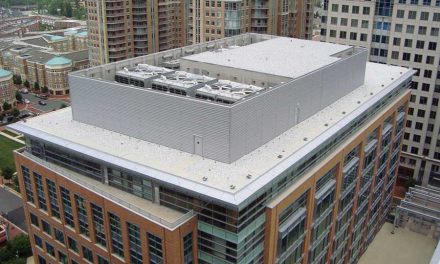
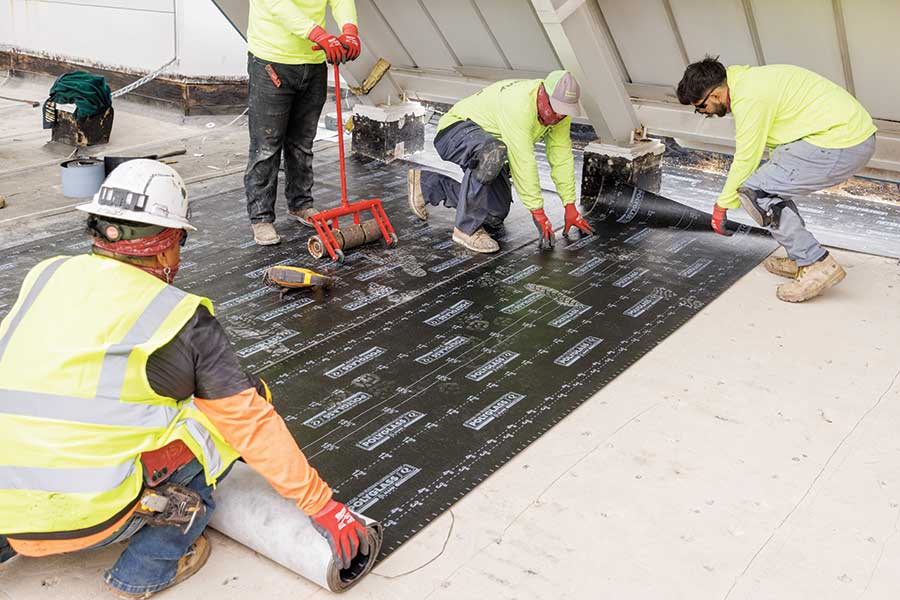
Polyglass Modifleece LWIC installation by McEnany Roofing Inc.

As storms intensify and build-ing codes tighten, roofing manufacturers and contractors are rethinking everything from adhesives to assembly sequencing in search of systems that can hold the line. The three dominant synthetic membrane types are TPO, EPDM, and PVC, and each carry their own legacy while also continuing to evolve.
In some scenarios, project conditions are leading designers to consider hybrid assemblies alongside single-membrane solutions.
Bill Bellico, LEED AP BD+C and vice president of marketing for Sika Roofing, traces the origins of modern commercial roofing to the late 1950s, when single-ply PVC membranes began displacing built-up roofing systems that had dominated the market for most of the 20th century.
PVC appeared in the US in the 1970s, following EPDM in the 1960s. But the real milestone came in 1962, when Sarna AGl — now part of Sika — introduced the world’s first reinforced single-ply PVC membrane, Sarnafil. The key distinction is in the seams. PVC is a thermoplastic with hot-air welded seams, while EPDM is a thermoset (rubber) that behaves more like rubber, with seams bonded by adhesives or tapes and primers.
TPO arrived in the 1990s, but has had its challenges in the U.S. “Some of the earlier generations of TPO formulations in the U.S. market had some performance challenges with high-UV exposure geographies,” Bellico noted, “so the jury is still out on how long a newer-generation membrane will last.” He pointed to EPDM as typically lasting 15 to 20 years, while PVC has demonstrated a track record of 25 to 30-plus years in the field.
PVC has its own complications, particularly in North America. Drew Line, business development manager for Soprema’s Sentinel synthetic roof system, described how early imports of unreinforced European PVC membranes gave the material a lasting stigma here. “If one takes an unreinforced PVC membrane that’s designed to perform in moderate European climates, and it is applied in Dallas, Texas, with intense UV exposure and heat that gets well over 100 degrees, it is not a great idea.” Line said. “Additional design and formulation work was needed to meet the demanding weather challenges across the U.S.”
That reputation has since shifted. PVC membranes with proper reinforcement and modern formulations have been performing reliably for decades in demanding U.S. climates. Line also noted growing interest in PVC-KEE (ketone ethylene ester), a PVC variant enhanced with a solid plasticizer that improves chemical resistance and can moderately enhance the durability of the sheet. Line calls it “PVC on steroids.”
Shipping reports show both PVC and PVC-KEE membranes were on the rise in 2025 while other categories were flat or declining. The price gap between commodity PVC and TPO has also narrowed since COVID, making PVC more accessible to budget-sensitive projects.
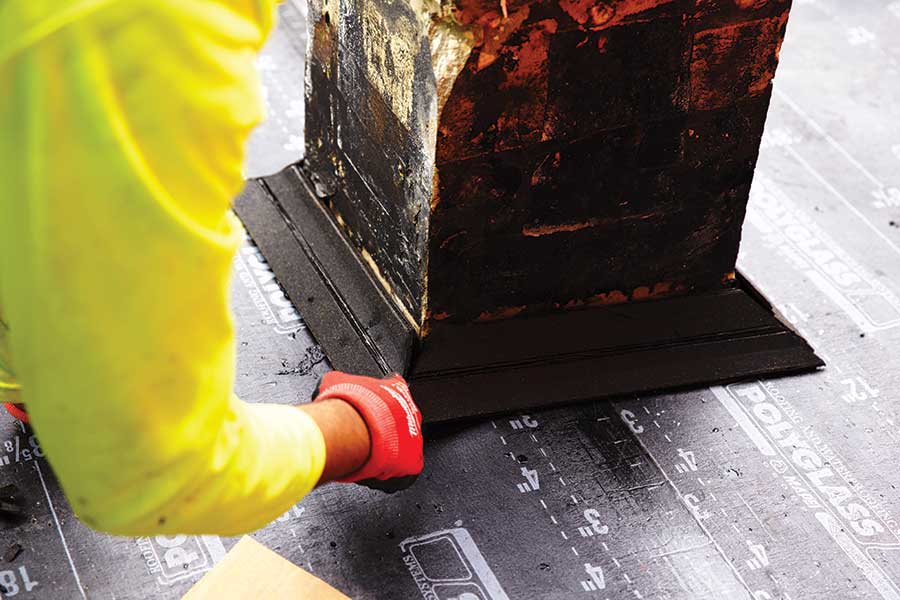
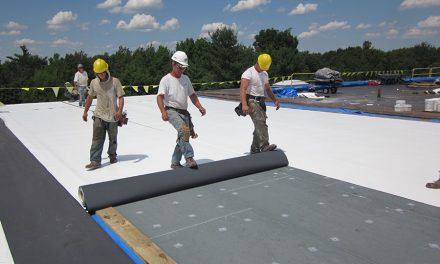
Polyglass Modifleece LWIC installation by McEnany Roofing Inc.
Extreme Weather And Roofing
The phrase “extreme weather resilience” covers hurricane-force winds, temperature cycling from well below freezing to triple digits, hail, UV exposure, and fire. Wind uplift is often where failures begin. “The wind is trying to lift the roof from the building,” explained Michelle McNerlin, low slope membranes product manager for Polyglass.
“When you’re looking at wind uplift values, you might see a negative psf MDP—maximum design pressure—and that represents the highest pressure that a tested assembly can sustain before failure, accounting for safety factors. Higher MDP values translate directly to better performance, especially in high wind and hurricane conditions,” she said. In high-wind zones, the response involves tightening fastener spacing, decreasing the width of perimeter sheets, and—increasingly—moving away from mechanical fasteners altogether.
McNerlin, who works with Polyglass’s Modifleece product, explained why fully adhered assemblies outperform mechanically fastened ones when the wind picks up.
“Fasteners puncture the base ply, meaning it no longer functions as a continuous waterproofing layer because you put holes in it,” she explained. “Those are often the first point of failure during high wind or severe weather events.”
If the base ply on a hybrid system does not have holes in it from fasteners, then you’re less likely to need an inner ply. So that’s one less sheet you have to put down, she explained.
“Every ply in a fully adhered assembly remains intact and monolithic, and that improves your overall performance,” she said.
Lightweight insulating concrete, or LWIC, is less dense than structural concrete so it’s more susceptible to cracking from fastener movement under uplift forces. “If you adhere the system, you reduce the stress on the deck and improve long-term durability,” McNerlin said.
There are other factors in determining the type of synthetic membrane to choose from. In northern climates, week-to-week swings of 50 or 60 degrees are common. Adhesives that work in moderate temperatures become difficult or impossible to use in below-freezing temperatures. Thermoplastic membranes offer some advantages because induction welded PVC systems can be installed in cold conditions by adjusting machine temperature settings.
Regarding fire resistance, PVC membranes are inherently self-extinguishing due to the chemical makeup of the PVC polymer. “Other synthetic membranes require significant ‘formulation work’ to pass the necessary fire testing, e.g., Underwriters Laboratories UL 790,” Line said. This inherent characteristic makes PVC popular and specified for hospitals, schools, airports, and high-density mixed-use buildings where fire ratings are a priority.
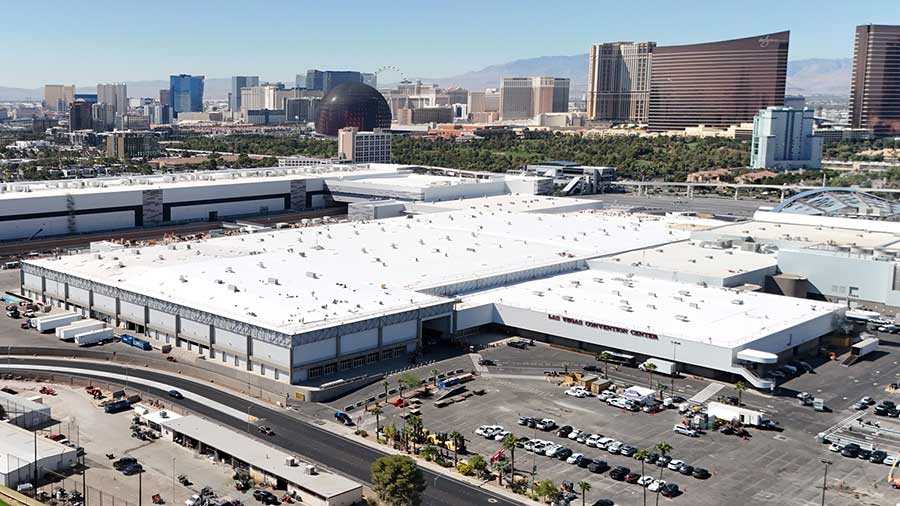
The Las Vegas Convention Center required more than 48 acres of new roofing that needed to be completed in 10 months. Farrell Roofing of Dunkirk, New York, used Sika’s induction-welded RhinoBond System for its superior wind uplift resistance and ability to reduce membrane flutter. The assembly included a 1/2-inch DensDeck cover board followed by an EnergySmart white Sarnafil PVC membrane, selected for maximum reflectivity in the desert sun, and Sika’s exclusive lacquer coating that reduces dirt and dust pick up.
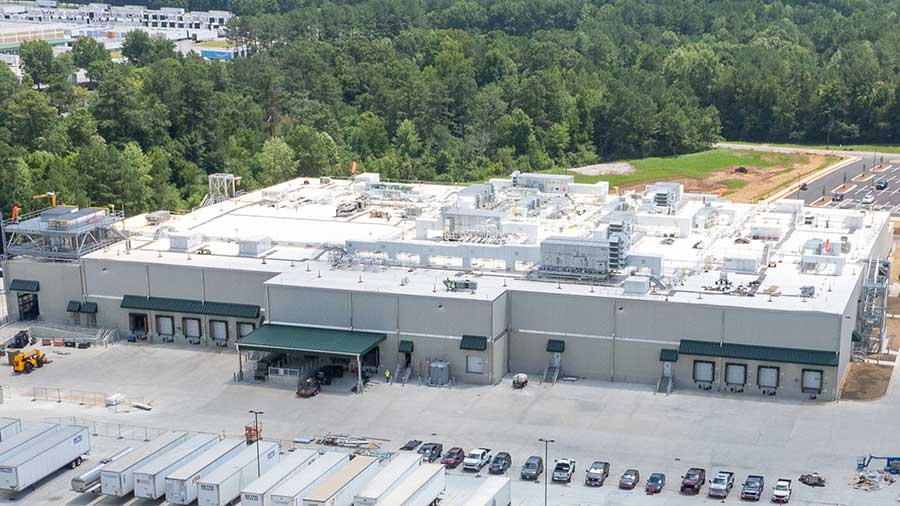
Midland Engineering Company, Inc., of South Bend, Indiana, completed the 141,500-square-foot roofing project for the Publix Fresh Kitchen facility in Dacula, Georgia. The roof covers freezer and refrigerated food production and storage areas, as well as office space and mechanical equipment areas. The assembly included three layers of 2-inch polyiso insulation with staggered joints, followed by 1/2-inch DensDeck coverboard. Midland then installed the Sarnafil PVC membrane over the top using Sika’s RhinoBond induction-welded system. Photos courtesy of Sika
The Case for Fleece-Backed
One significant technical development in recent years is fleece-backed membranes installed with low-rise foam adhesive. The approach eliminates fasteners entirely while improving adhesive bond strength. Fleece in this context is a nonwoven polyester fabric laminated to the underside of the membrane. It’s the same basic material concept as geotextile fabric, meaning a dense mat of synthetic fibers that creates a textured, porous surface the adhesive can grip into.
The fleece backing functions as a mechanical anchor for the adhesive. “It distributes the load of any uplift loads evenly across the roof surface, rather than localizing them to specific fastener locations,” McNerlin explained. With a spatter pattern application — she compared it to the first moments of rain on a concrete sidewalk — the foam creates multiple contact points and then expands slightly into the fleece, locking the sheet in place before it cures.
Designed for high performance over LWIC and installed with low-rise foam adhesive, Polyglass’s Modifleece is a patent-pending SBS-modified bitumen sheet with fleece-to-SBS (styrene-butadiene-styrene) lamination technology that delivers uplift values up to -262.5 psf MDP over lightweight concrete substrates. “The fleece grips so aggressively to the low-rise foam,” McNerlin said, “it just makes this incredible bond.”
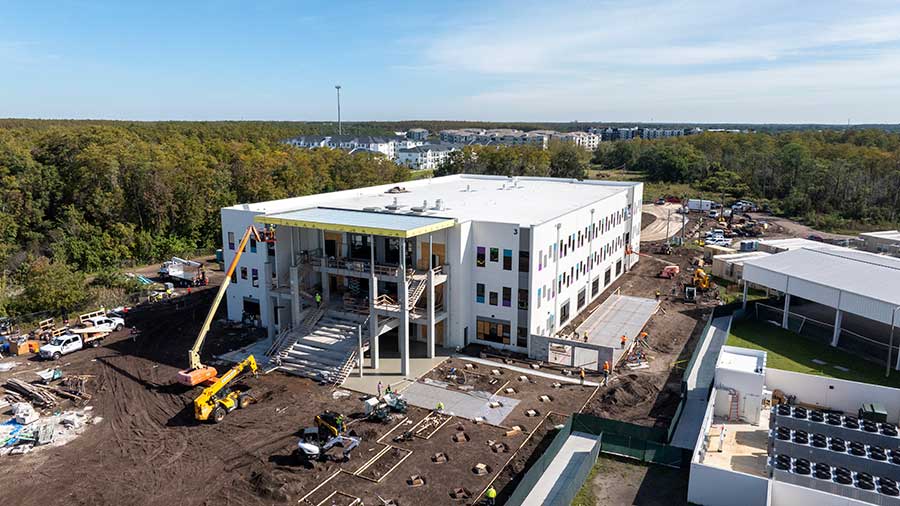
Osceola County School for the Arts in Kissimmee, Florida. Photo courtesy of Soprema
Soprema also offers fleece-backed 60- and 80-mil membranes in both PVC and PVC-KEE formulations. Beyond wind performance, fleece-backed adhered systems are also faster to install. Over lightweight insulating concrete, which cures in two to four days versus the 28 days required for structural concrete, a single fleece-backed ply applied in low-rise foam can waterproof a roof almost immediately after the deck is ready, describes McNerlin. “You can start putting the interior finishes in within less than a week of pouring the roof deck versus being longer than a month,” McNerlin said.
That speed advantage was central to a recent project at Bayshore Regency, a 19-story coastal condominium in Tampa with 75 squares of roof area across multiple substrate types, including both lightweight insulating concrete and metal decking. Delayed mechanical equipment meant the roof had to be installed in phases, with each completed area needing to be watertight immediately. The fleece-backed system allowed the crew to meet high-wind performance requirements, maintain a watertight condition throughout Tampa’s rainy spring season, and complete the job when conditions allowed.
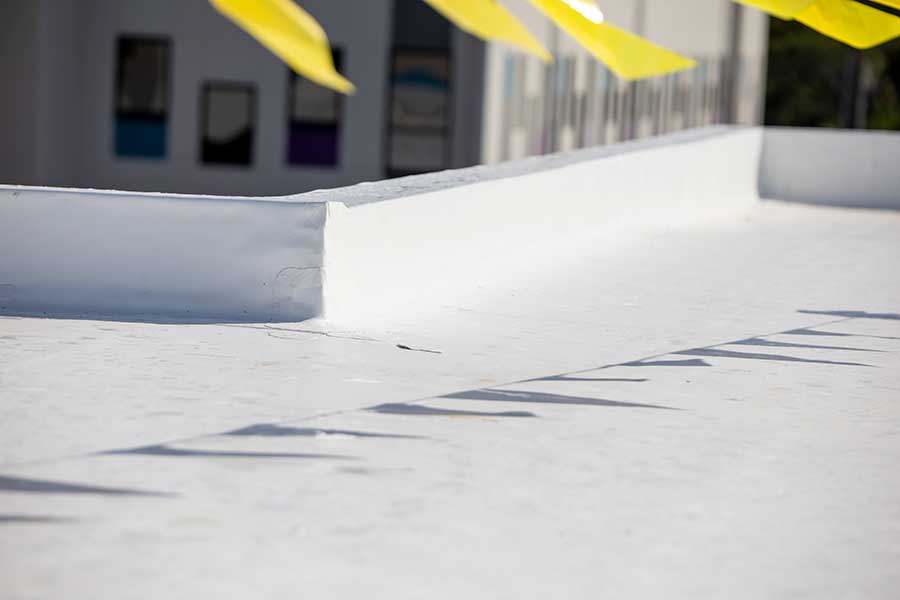
Osceola County School for the Arts in Kissimmee, Florida. Photo courtesy of Soprema
Hybrid Systems
Hybrid systems include assemblies that combine synthetic membranes with modified bitumen base plies to achieve redundancy and take advantage of each material’s strengths.
Sika’s Bellico described it as a bituminous base ply layer with a single-ply membrane acting as the waterproofing cap sheet layer. While still a small percentage of total installations, hybrid systems appeal to specifiers who want the durability of two distinct waterproofing layers and to contractors who appreciate that they can quickly dry the building so other trades can start working, then they can go back and add the PVC later.
The hybrid approach solves sequencing challenges by using the modified base sheet as a watertight, robust surface that other trades can safely work over. “A torch-applied modified base sheet is installed and then you can allow other trades to do their work on the roof; whether it is HVAC, electrical, plumbing, safety railing, whatever it might be,” Line said. “Due to the forgiving nature of the modified bitumen, any incidental damage caused by other trades is easily repaired. And then when they’re done, you return and install a fleece-back PVC membrane in low-rise foam. The modified bitumen then acts as additional waterproofing in this synthetic/modified bitumen hybrid membrane.”
Data centers and food production facilities are a hot topic in the roofing world and construction right now. Food manufacturing has risen more than 40% since early 2021, according to Dodge Data and Analytics. Both of these commercial efforts require durable roofing that resists chemical corrosion, oils, and animal fats that also meets strict safety and hygiene codes.
“Hybrid systems are being used because of their multiple system approach,” says Brian Blaquiere, Sika’s director of marketing communications. “Systems like these are very important to data centers because if a leak were to happen and cause problems to the data servers in the building, that would mean hundreds of thousands, if not more, a day in lost revenue.” The same thing holds true for food production facilities.
Selecting for Performance
With so many products and performance claims in the marketplace, Bellico quoted the late Carl Cash of Simpson, Gumpertz & Heger, who conducted a landmark examination of single-ply membranes in the late 1990s. Cash concluded, “The only rational procedure for selecting a roofing system is its past performance on the roof in the same climate as the new project.”
That standard still holds, Bellico argued. Manufacturers sometimes highlight individual ASTM test results to imply overall superiority, but a single data point is not a substitute for decades of documented performance in comparable conditions.
“Even if a manufacturer has a slightly lower result in one specific category, if they can show you many examples of their roof performing for decades and share roofs they have done in your project area, that is the true indicator of what to expect for performance,” Bellico said.
Thicker membranes are one advance with a clear performance rationale. Where 40- to 50-mil sheets were common in the first generation of single-ply products, 60 mil became the standard by the early 2000s, and 72 and 80-mil membranes are increasingly specified for mission-critical buildings. “It is the membrane that keeps the water out of the building, not the warranty,” Bellico noted. “Thicker membranes mean a more durable product that should last longer and withstand ever-increasing extreme weather.”
Line echoed the broader theme that new products are welcome in the marketplace but only if they’re backed by intense testing and field validation. “With innovation comes responsibility,” he said, emphasizing that new products must prove their performance before widespread adoption.
The roofing industry is by nature conservative, for good reason. A roof that fails causes expensive repairs and possibly revenue loss, production downtime, and loss of building contents such as stored food or valuable servers. But the current generation of hybrid, fully adhered assemblies demonstrates that the systems available today are faster to install, better bonded, and more durable than anything the market offered a generation ago.
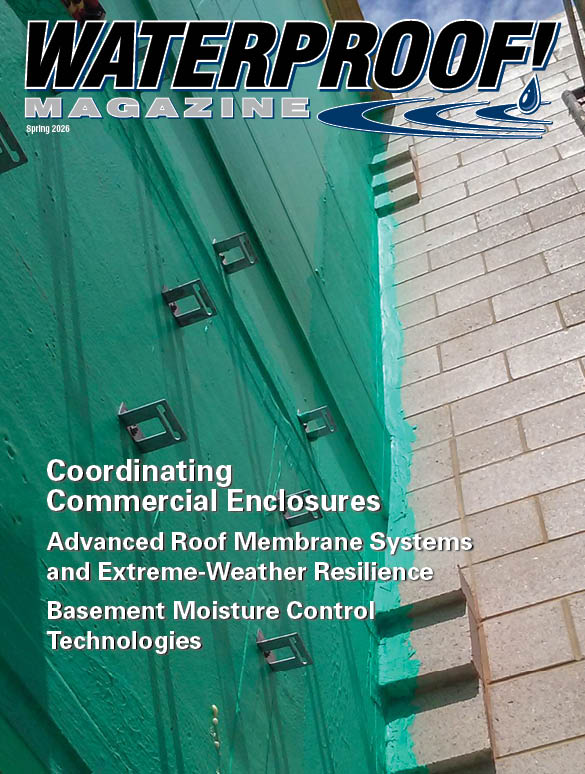
Spring 2026 Back Issue
Price range: $4.95 through $5.95
Advanced Roof Membrane Systems and Extreme-Weather Resilience
Basement Moisture Control Technologies:Smart monitoring systems, automated dehumidification, and IAQ management
Integrating the Control Layers: Coordinating Air Barriers, Vapor Retarders, and Insulation in Commercial Enclosures
Marine Waterproofing: Turning the Tide with Durable Concrete
Description
Description
Advanced Roof Membrane Systems and Extreme-Weather Resilience
By Vanessa Salvia
The three dominant membrane types are TPO, EPDM, and PVC, and each carry their own legacy while also continuing to evolve. Increasingly, though, the best option isn’t a single membrane but a hybrid assembly.
Basement Moisture Control Technologies:Smart monitoring systems, automated dehumidification, and IAQ management
By Vanessa Salvia
Basements are easy to ignore … until they’re not. Tools available today make it possible to manage basement air quality continuously, without requiring homeowners to pay constant attention.
Integrating the Control Layers: Coordinating Air Barriers, Vapor Retarders, and Insulation in Commercial Enclosures
By Jonnie Hasan and Wes Settlemyre
Most commercial envelope failures happen at the seams, not the surfaces — and fixing that requires systems thinking, not better products.
Marine Waterproofing: Turning the Tide with Durable Concrete
By Vanessa Salvia
The ocean has always been a hostile place for concrete. Seawalls, dry docks, piers, and bulkheads that once seemed permanent are showing their age, and their vulnerabilities.
Additional Info
Additional information
| Weight | N/A |
|---|---|
| Magazine Format | Digital Download Magazine, Print Mailed Magazine |