
Beyond 6-Mil Poly: The Case for Class A Vapor Barriers
By Vanessa Salvia
Images courtesy of ISI Building Products
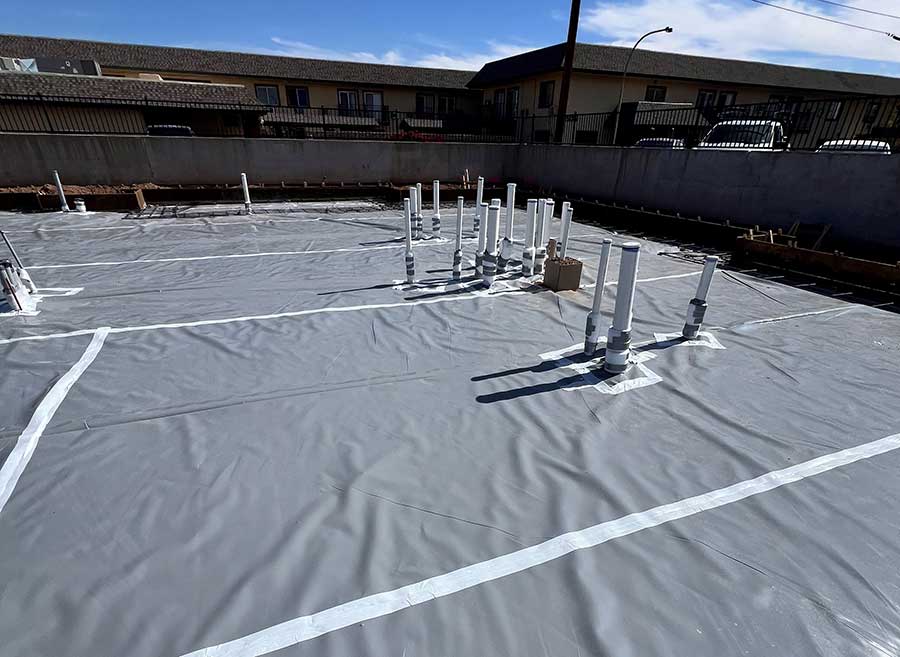
10-mil Class A vapor barrier installed on a commercial project. Image shows penetrations and seams sealed with vapor-retarding tape.
Moisture intrusion through concrete slabs remains one of the most challenging issues for waterproofing professionals to remedy after construction. As the industry moves away from traditional polyethylene sheeting, understanding the specifications and benefits of high-performance vapor barriers has become essential for protecting both commercial and residential structures.
Understanding ASTM E 1745 Standards
The foundation of effective underslab moisture protection lies in ASTM E 1745, the standard for vapor retarders used in contact with soil or granular fill underneath concrete slabs.
“Within that standard, it designates performance properties as being a Class A, B, or C. Class A represents the highest performance level,” explains Dario Lamberti, CSI, an expert in underslab moisture protection systems and general manager of ISI’s Engineered Films Division. “The differentiating factors within each classification are going to be the puncture resistance and the tensile strength.”
Class A vapor barriers are the industry’s recommended standard, with specific and demanding requirements. The Class A standard sets a puncture resistance requirement of 2,200 grams of impact resistance. The tensile strength requirement is 45 pounds of force per inch.
“The higher the tensile and puncture resistance, the better the material will perform against potential pathways, tears, punctures, and anything that will allow water vapor to transfer through it and then eventually into the concrete,” Lamberti says.
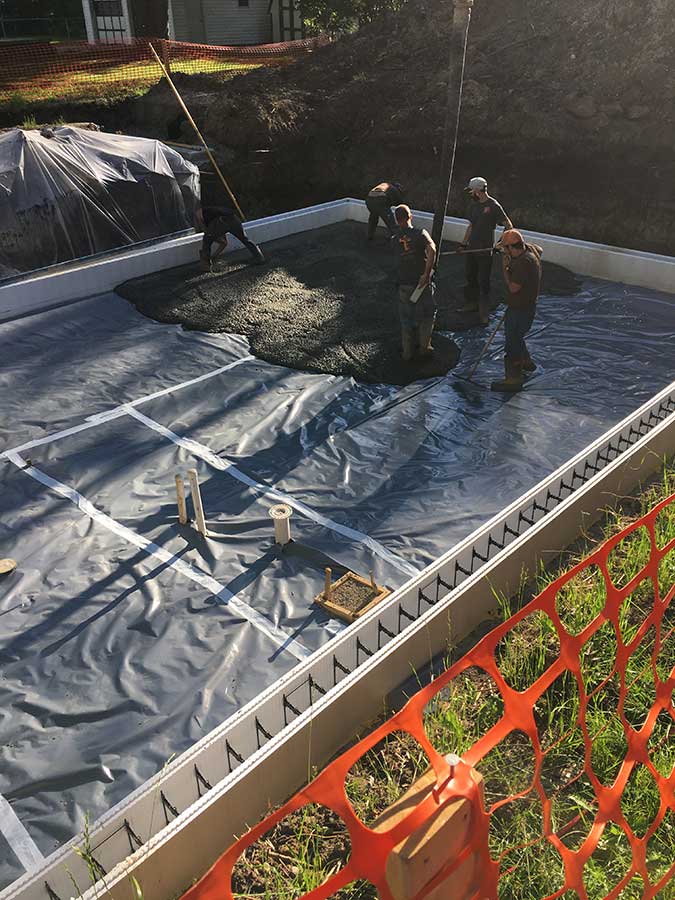
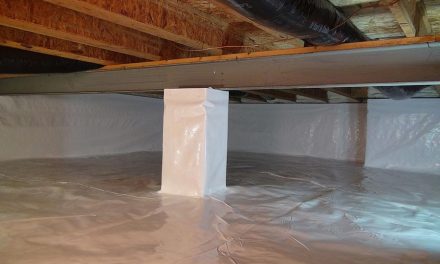
8-mil Class A vapor retarder installed for a residential home with an ICF foundation. Image shows concrete placement directly over the vapor retarder as recommended by ACI 302.
The Problem with Traditional Materials
Traditional 6-mil polyethylene sheeting has long been used as the economical option. But it falls significantly short of these requirements.
“Traditional 6-mil polyethylene sheeting has a very, very low impact resistance,” Lamberti notes. “So our industry is trying to get away from that by highly recommending the use of an ASTM E1745 Class A vapor retarder, as opposed to traditional clear plastic sheeting.”
The general expected impact resistance for 6-mil sheeting is around 260 grams of puncture/impact resistance, based on common industry test results. 6-mil poly, commonly manufactured from recycled content, loses longevity due to the unknown reprocessed resin blends, Lamberti says.
Manufacturing Makes the Difference
High-performance vapor barriers achieve Class A properties through advanced manufacturing processes. ISI manufactures all of its vapor barriers using virgin resin, meaning resin that has not been pre-melted or used in other applications.
While recycled materials serve important sustainability goals in many construction applications, virgin resin is better for vapor barriers because products made with 100% virgin resin are more resistant to punctures and tears. Virgin resin provides superior durability, long-term stability, and consistent performance compared to recycled resins.
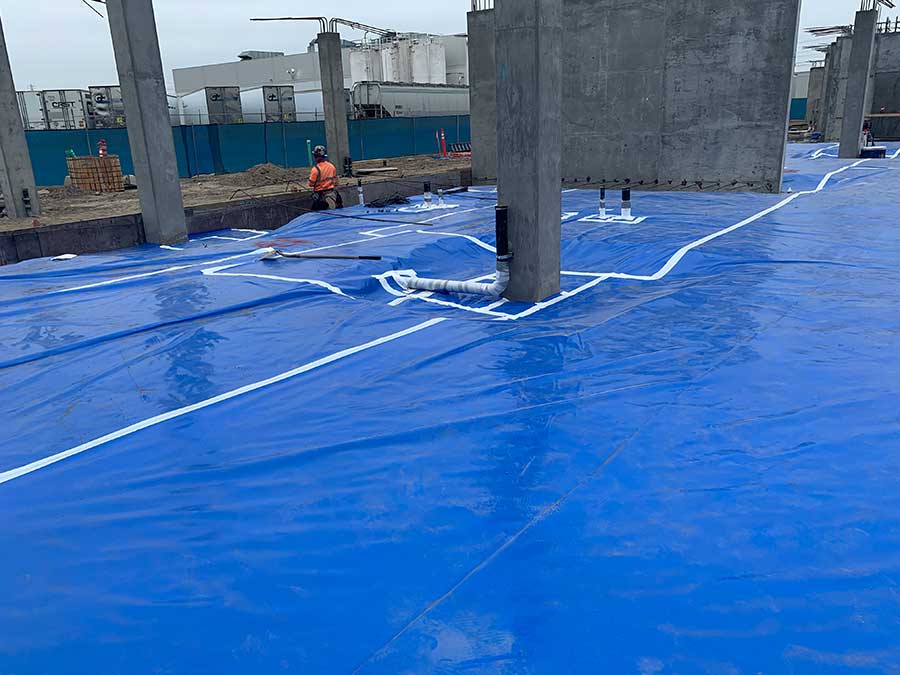
15-mil Class A vapor barrier installed on a commercial project. Image shows penetrations and seams sealed with vapor-retarding tape.
The multi-layer construction is equally important.
“How you get to reaching those Class A properties is to use a multi-layer manufacturing process,” Lamberti explains. “We call it a co-extruded multi-layer film.”
A cross section of ISI’s plastic vapor barriers reveals a minimum of three layers, with up to seven different layers possible.
“Each layer is a blend of the resin mixture based on performance properties, which creates a material using all-virgin resin that will have good puncture resistance, tensile strength, and low water vapor permeance rating,” Lamberti says.
In contrast, traditional polyethylene sheeting is often manufactured using recycled content and a single layer of plastic.
Commercial Applications
Class A vapor barriers are increasingly specified in commercial construction, where the stakes are high. The primary driver for this specification is protecting floor finishes.
“The high-performance vapor barrier industry was created to protect floor finishes that are glued down onto the concrete floor,” Lamberti explains. “Any moisture that is allowed into the concrete through either vapor diffusion or physical water raises the pH level within that concrete, and high pH levels will attack the adhesive and basically cause it to fail.”
But flooring isn’t the only concern. Controlling relative humidity inside buildings used for warehouses, distribution centers, and data centers, for instance, is highly important. Any material that is stored on the floor of a warehouse or data center could potentially develop moisture if it goes unprotected.
“Even if a warehouse or a building does not have a finished flooring system installed, it’s still important to have protection underneath,” Lamberti says.
Residential Considerations
While some view Class A vapor barriers as an expensive upgrade for residential projects, Lamberti argues that the cost-benefit analysis favors investing in quality. In other words, spending hundreds to save thousands is a good investment.
“People look at Class A vapor barriers as being an expensive add-on to the building,” he acknowledges. “We would argue that once you pour the concrete, it’s very hard to remedy any moisture problems caused by below-slab conditions. Spending a couple hundred dollars extra on an average home for a higher-performing vapor barrier is going to remedy any long-term effects you’re going to have within the home.”
Installing carpet or flooring in a finished basement in a residential home, for instance, could potentially be impacted with the installation of an inferior vapor retarder, Lamberti says. “Our argument is, why jeopardize the health of your home for a minimal upfront expense? The cost to remedy any issues are going to far outweigh the cost of upgrading the under-slab vapor barrier.”
Added Protection: Radon Resistance
High-quality Class A vapor barriers offer an additional benefit beyond moisture control. Radon is not always on everyone’s mind, but it should be. There are radon zones throughout the country, which the Environmental Protection Agency has mapped [https://www.epa.gov/radon/epa-map-radon-zones].
In fact, most of the country is in a red “highest potential for danger” zone, in which average indoor radon levels may be greater than 4 pCi/L (picocuries per liter). The EPA recommends homeowners take action if their radon level is 4 pCi/L or higher, and that homeowners should consider fixing their radon level if it falls between 2 and 4 pCi/L.
There are no immediate symptoms of radon exposure, which is an odorless, colorless gas. However, long-term exposure is dangerous because it is a leading cause of lung cancer, behind smoking.
“A lot of the materials, such as ours, that meet high-quality Class A requirements also have good radon-diffusion coefficients, so they resist that radon gas when installed properly,” Lamberti says.
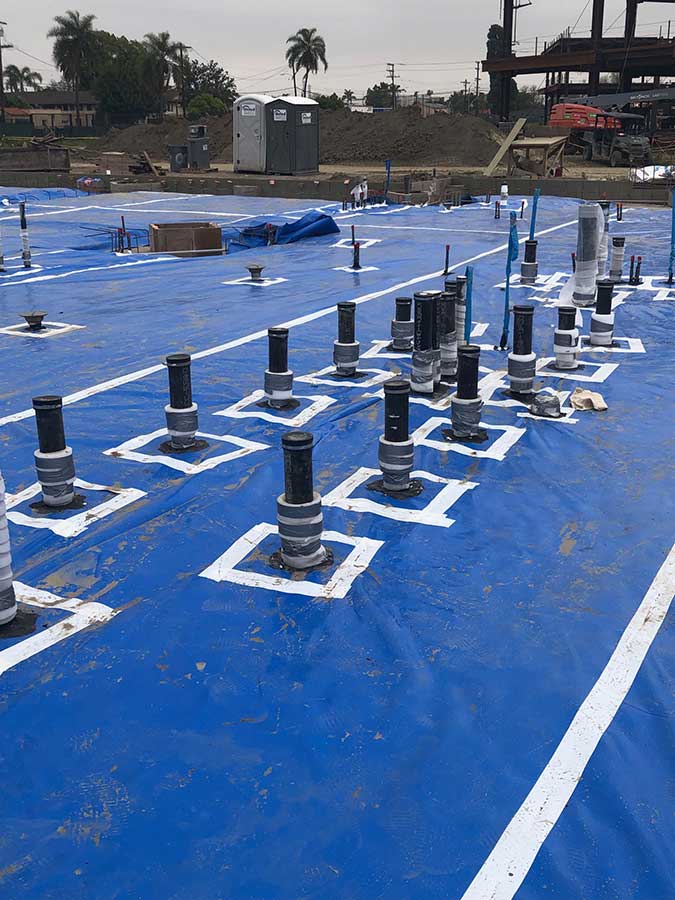
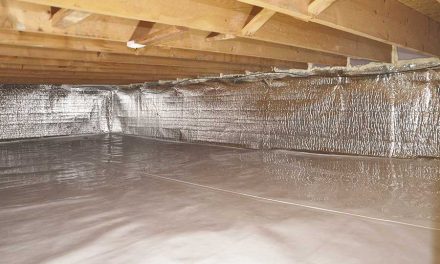
15-mil Class A under-slab vapor barrier with utility penetrations sealed with 4-inch vapor-retarding tape and waterproofing mastic.
Installation Best Practices
Even the highest-performing vapor barrier requires proper installation to be effective. The ASTM E1643 standard explains the best practices for the installation of underslab barriers. The fundamental principle is creating a continuous, uninterrupted barrier beneath the concrete slab, with properly overlapped and sealed seams, careful detailing around penetrations, and edge termination that prevents moisture from bypassing the system.
“Essentially, create a bathtub for the concrete and then take the ground out of play,” Lamberti says. The key is installing the vapor barrier so it creates a continuous, watertight envelope—not just laying it flat on the ground, but bringing it up the foundation walls to form a basin or “tub” that the concrete sits in. This prevents moisture from entering through the slab or wicking around the edges. Then create an impermeable barrier beneath the concrete, completely blocking moisture transmission from the soil below.
The subgrade should be properly prepared with a smooth, compacted surface free of sharp objects that could compromise the membrane. During construction, protecting the installed barrier from damage caused by foot traffic, equipment, or materials placement is equally important. Any gaps, punctures, or unsealed seams create pathways for moisture intrusion, undermining even the most advanced vapor barrier technology.
The Bottom Line
Lamberti’s recommendation is straightforward: “Virgin resin material and products that meet the ASTM E1745 standard—that’s going to be your best approach to stopping water vapor into a residential home or commercial construction building.”
Moisture problems are difficult and expensive to remedy after concrete placement. The time to ensure proper protection is before the pour, when investing in a Class A vapor barrier can prevent repairs and maintain structural integrity for decades to come.
Winter 2026 Back Issue
Price range: $4.95 through $5.95
World of Concrete Preview
Deep Foundation Waterproofing: Why a Holistic Approach Matters
Polyurea Coatings: A Fast-Curing Solution for Waterproofing Concrete Decks
Beyond 6-Mil Poly: The Case for Class A Vapor Barriers
Managing Shrinkage Cracks in HCA-Waterproofed Concrete Structures
Description
Description
World of Concrete Preview
Explore waterproofing-related businesses and educational sessions at World of Concrete.
Deep Foundation Waterproofing: Why a Holistic Approach Matters
By Lisa Semling
With limited above-grade space, developers are increasingly turning to subgrade levels to house essential functions such as parking, storage, healthcare facilities, retail, and data infrastructure. But, the deeper the foundation, the more intense the challenges.
Polyurea Coatings: A Fast-Curing Solution for Waterproofing Concrete Decks
By Vanessa Salvia
Polyurea coatings offer a combination of seamless application, superior durability, and remarkably fast cure times that are changing how waterproofing projects are specified and executed.
Beyond 6-Mil Poly: The Case for Class A Vapor Barriers
By Vanessa Salvia
Moisture intrusion through concrete slabs remains one of the most challenging issues for waterproofing professionals to remedy after construction.
Managing Shrinkage Cracks in HCA-Waterproofed Concrete Structures
By David Webster, PE, SE, Ph.D
This article examines how hydrophilic crystallizing admixtures (HCAs) used as waterproofing in concrete structures require careful crack width control, as demonstrated by a Seattle building case study where inadequate reinforcing led to cracks exceeding the HCA’s self-healing capacity.
Additional Info
Additional information
| Weight | N/A |
|---|---|
| Magazine Format | Digital Download Magazine, Print Mailed Magazine |