By Vanessa Salvia
Photos courtesy of EPRO
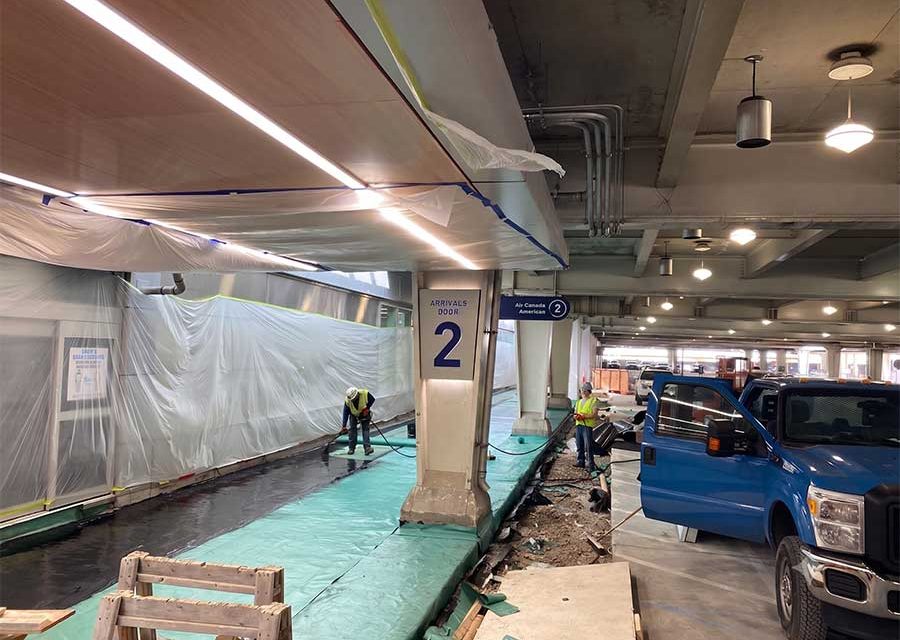
Installation of HydroGel at the curb areas in front of the arrival zones at Minneapolis-Saint Paul International Airport.
With new construction, contractors often have all the details of the substrate to which waterproofing will be applied. In restoration waterproofing, the substrate and waterproofing system are often unknown, and the building may have already been through at least one construction cycle. “It’s probably one of the more challenging waterproofing scenarios,” says Scott Schendel, EPRO’s director of product development.
Restoration work is, by definition, waterproofing layered on top of a building that’s already been through at least one construction cycle. “Probably one of the more challenging aspects of waterproofing” is how Schendel describes it. Because waterproofing work has already been done, you don’t always know what you’re going to find.
Working With an Existing Substrate
In new construction, there’s nothing on the substrate yet. In restoration, there already is. And on top of that, you may not know what repair work may have been done.
“In waterproofing, probably one of the most important things to take into account is the substrate,” Schendel says. “But in restoration waterproofing, the substrate already has, in most cases, a waterproofing membrane on it — maybe a failed waterproofing membrane, because that might be one of the reasons they’re doing a restoration.”
Preparing that substrate, he says, is typically the single most labor-intensive and challenging part of the job.
The Unknowns
Every restoration project carries its own set of surprises, Schendel explains, and much of that uncertainty traces back to incomplete records. The documentation reflecting what was actually constructed is often unreliable.
“Sometimes those as-built plans are incomplete, or you don’t have those at all,” he says, “so you might excavate out a foundation wall or take a plaza deck off, and you’re just kind of doing a forensic discovery” to determine what waterproofing was used and where.
Building envelope consulting firms typically lead front-end investigation, working with the owner or condo association to review as-builts. When needed, they will excavate test sections to verify what the plans show. The International Concrete Repair Institute publishes technical guidelines — including ICRI 310.2R for evaluating concrete surface preparation and moisture-testing protocols — specifically to help contractors, engineers, and owners assess existing substrate conditions using consistent, repeatable field methods before a repair scope is finalized. Even with that process in place, Schendel notes, you can’t really be certain of anything until the crew reaches the substrate itself.
Ultimately, the lack of knowledge means crews are frequently making decisions in real time. “Sometimes you might think you have a complete understanding of the structure,” Schendel says, “and then you end up removing overburden and find out it is something completely different.”
These unknowns can also affect cost: Applicators tend to price restoration work higher than new construction. “In construction, uncertainty equals risk equals more money,” Schendel says.
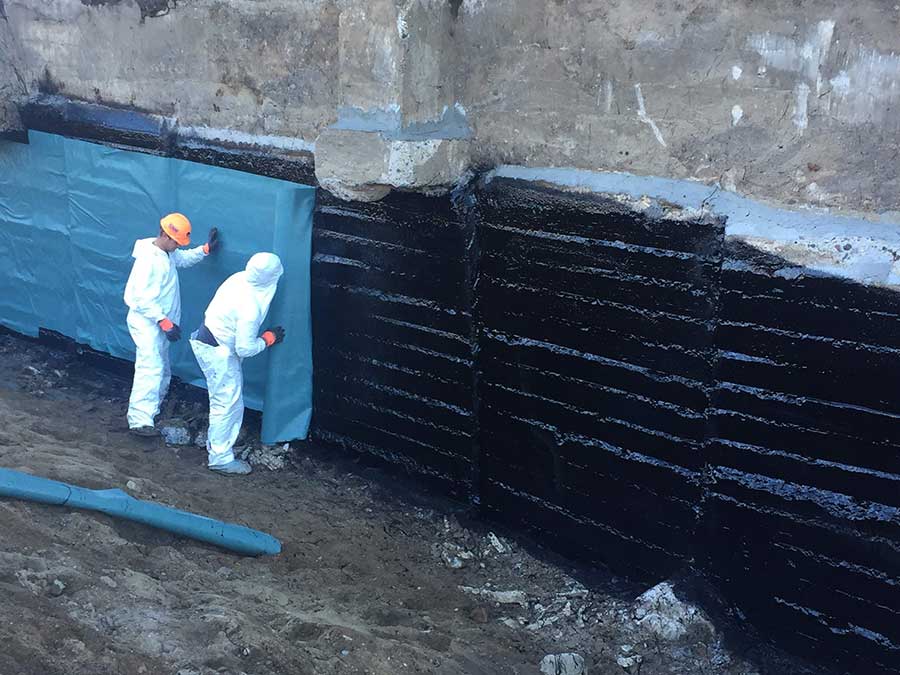
Spray-applying HydroGel at the Northern Stacks building.
Outdated or Unsafe Materials
Asbestos was commonly used in the U.S. from the early 1900s through the 1980s in products like roofing shingles, cement sheets, pipe wrap, vinyl floor tiles, millboard, and roofing felt due to its fire resistance, strength, and durability. In many restoration cases, existing waterproofing materials often need to be tested for the presence of asbestos. “Some jurisdictions, or most, would require some sort of abatement, which is costly and time consuming,” Schendel says.
In March 2024, the U.S. Environmental Protection Agency finalized a rule under the Toxic Substances Control Act (TSCA) to ban chrysotile asbestos, covering its import, processing, distribution, and commercial use. Chrysotile asbestos was the only form of asbestos still imported and used in the United States. Despite this 2024 rule, “legacy” asbestos-containing materials already installed in buildings remain in place and are not required to be removed. Instead, they are regulated mainly during demolition or renovation to prevent fiber release.
Coal tar pitch presents a different but equally serious hazard, and one with direct relevance to waterproofing crews. “That can burn an applicator just by having it exposed on skin,” Schendel says. The federal Occupational Safety and Health Administration lists roofing among the industries where workers face regular exposure to coal tar pitch volatiles, which are released when the material is heated, and the International Agency for Research on Cancer classifies coal tar pitch as a known human carcinogen linked to skin and lung cancer. OSHA regulates worker exposure to these volatiles under its general air contaminants standard, with a permissible exposure limit of 0.2 mg/m³ measured as benzene-soluble aerosol. Both hazards, Schendel points out, have to be identified and addressed before any new waterproofing goes down on the restoration substrate — making material identification an early and essential step rather than an afterthought.
Commercial Projects
Restoration work is often required on commercial buildings such as hospitals, schools, or airports, as these structures commonly experience additions or expansions. These institutional structures are often where ongoing additions and expansions are the norm. In that scenario, Schendel says, contractors need to consider “how the new waterproofing is going to tie into the existing waterproofing,” along with the extents of each system, whether the two materials are chemically and physically compatible, and when the manufacturer’s warranty on the existing installation actually expires.
This kind of planning typically happens in the pre-construction phase, alongside the forensic review of as-builts and test excavations. Industry guidelines such as ACI 546R, the American Concrete Institute’s concrete repair guide, cover this kind of compatibility question and enable specifiers to solve issues before a tie-in detail is finalized in the field.
Why Restoration Bids Run Higher
Applicators tend to price restoration work higher than new construction, and it’s because the many unknowns inherent in restoration work show up in the pricing.
“In construction, uncertainty equals risk equals more money,” Schendel says.
Without thorough front-end planning, restoration jobs are more prone to change orders and unforeseen-condition costs once work is underway.
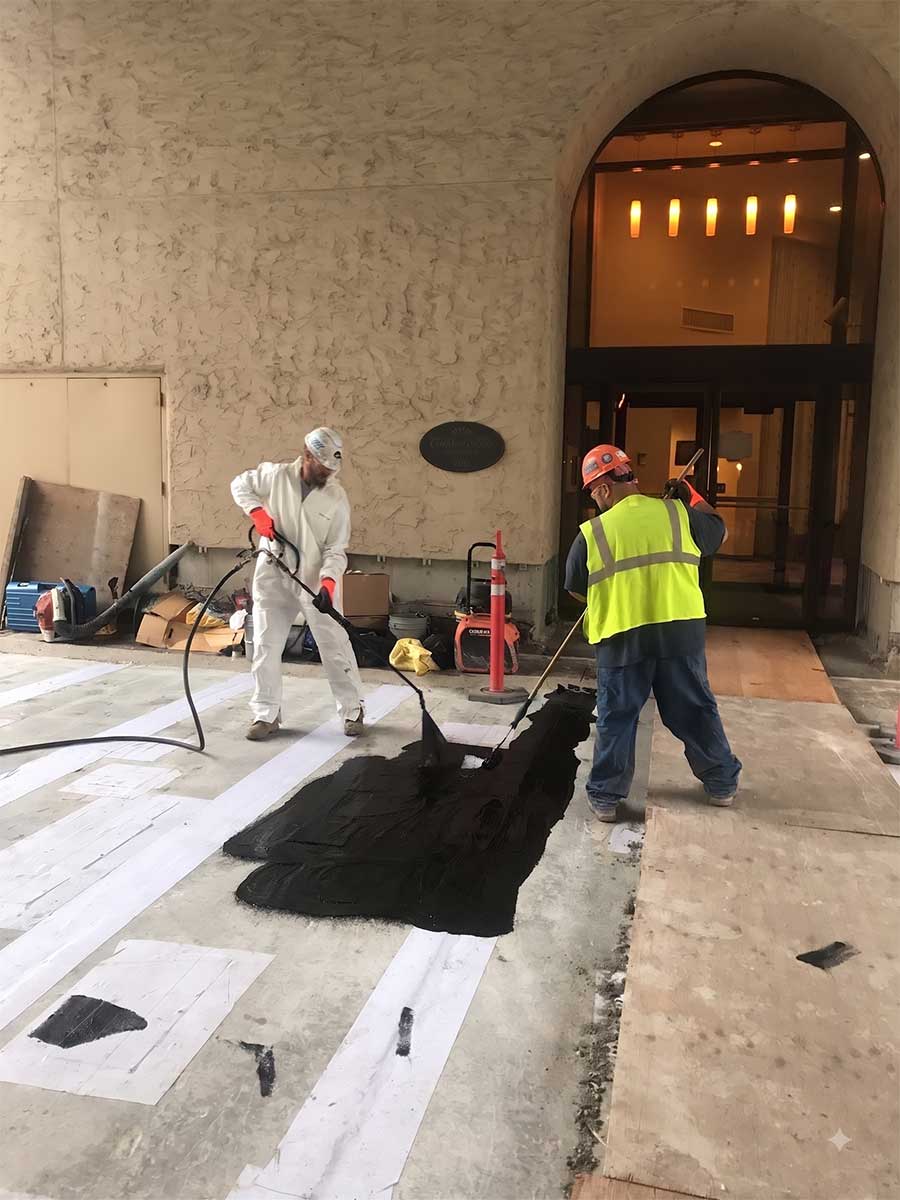
HydroGel application on exposed split slab restoration.
Choosing a Membrane for an Irregular Substrate
Contractors can technically use almost any type of waterproofing membrane on a restoration project, but “fluid applieds are a bit more the go-to,” Schendel says, because of their ability to conform to an irregular substrate. Polymer rubber gel materials, in particular, have “a long history of use in restoration applications because they’re highly adhesive and conform well to the irregular substrates.”
Some materials allow crews to install over an existing membrane rather than tearing down to bare concrete. “So long as it’s fully adhered, there’s no delamination or blistering,” Schendel says. That flexibility can meaningfully change the labor and cost of a project, which is one more reason he considers material selection among the most important decisions on any restoration job.
ASTM International maintains standardized pull-off and bond-strength test methods, commonly referenced in ICRI and IIBEC technical literature, that give contractors a documented basis for deciding whether an existing membrane is sound enough to build on top of.
The Takeaway
Restoration waterproofing asks more of contractors at every stage. It takes more investigation before the bid, more caution when hazardous legacy materials are involved, and more coordination on tie-ins and warranties when the project already includes an existing system. Knowing the substrate’s actual condition, rather than assuming it, is what keeps a restoration project from running into costly surprises mid-build.
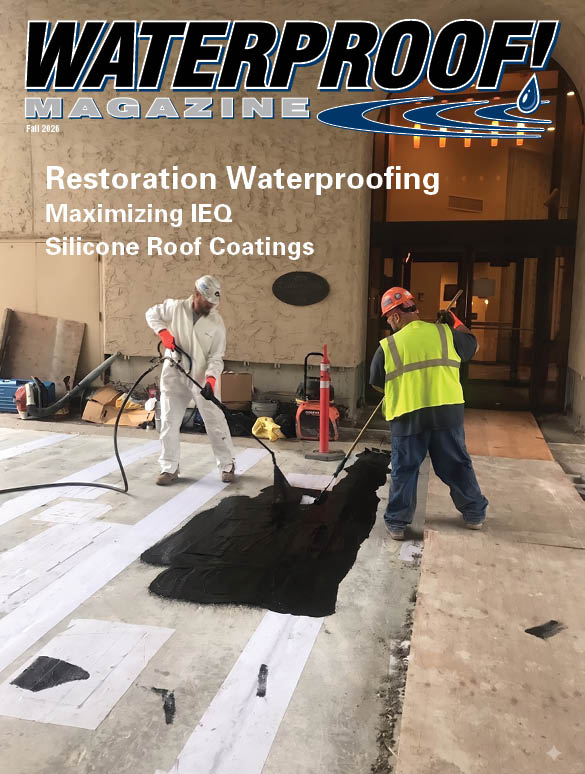
Fall 2026 Back Issue
Price range: $4.95 through $5.95
Managing the Roof as a Building Asset
What Contractors Need to Know Before Taking on Restoration Waterproofing
The Monolithic Defense: Why Silicone is the Strategic Play for High-Stakes Assets
Indoor Environmental Quality Starts From the Ground Up
Description
Description
Managing the Roof as a Building Asset
By Vanessa Salvia
Many owners can’t say what kind of roof their building has. Even if they do know, the attitude often amounts to: We’ll deal with it when it leaks.
What Contractors Need to Know Before Taking on Restoration Waterproofing
By Vanessa Salvia
New-construction waterproofing gives contractors a known substrate. This is something restoration work almost never offers.
The Monolithic Defense: Why Silicone is the Strategic Play for High-Stakes Assets
By Errol Bull, P.E., CSI
Shifting from traditional “seamed” systems to a monolithic silicone roof coating strategy can transform the building envelope from a depreciating liability into a durable, high-performing investment.
Indoor Environmental Quality Starts From the Ground Up
By Vanessa Salvia
IEQ is a broad term that describes everything that shapes how healthy, comfortable, and durable a home actually is. And according to the EPA, it deserves more attention than it gets.
Additional Info
Additional information
| Weight | N/A |
|---|---|
| Magazine Format | Digital Download Magazine, Print Mailed Magazine |